
Why Most Modern Businesses Are Working Harder Than Necessary
Most businesses today are operating with outdated systems that create hidden friction, wasted effort, and unnecessary workload. This article reveals why modern businesses work harder than they need to, how subtle inefficiencies accumulate over time, and why upgrading structure—not increasing effort—is the key to sustainable growth.
WAKE-UP CALL (AWARENESS)
Akash Dhotre
6/8/20252 min read

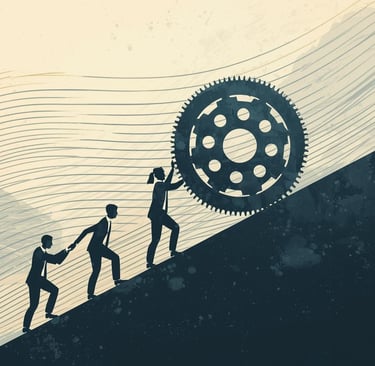
Why Most Modern Businesses Are Working Harder Than Necessary
Most businesses today are operating with an invisible handicap. They are still running on structures, habits, and workflows designed for a world that no longer exists. On the surface, everything seems fine: clients come in, work gets done, the team stays busy, and the day feels productive. But underneath this familiar rhythm is a quieter truth — most modern businesses are working far harder than they need to.
The reason is simple: the world evolved, but their systems didn’t.
Technology changed how customers behave, how information moves, how decisions are made, and how expectations are formed. Yet many businesses are still using manual processes, scattered tools, and outdated operational rhythm because “this is how we’ve always done it.” The result is not just inefficiency — it’s friction. Tasks that should take minutes take hours. Work that should flow smoothly gets stuck in tiny bottlenecks. Customer experiences that could be seamless become slow and inconsistent. And teams that should be focused on meaningful work spend their days putting out fires.
Most business owners don’t notice this slowdown immediately. It’s subtle. It shows up as constant busyness without real progress. It shows up as long days and repeated tasks. It shows up as missed opportunities, delayed follow-ups, forgotten conversations, and small errors that accumulate into bigger problems. And it shows up most clearly when owners feel mentally overloaded, even though their business has not grown proportionally.
The truth is that businesses don’t fall behind because of laziness or lack of effort. They fall behind because they operate in a world where the workload has multiplied, but the systems have not evolved to support it. The gap between demand and structure widens, and hard work becomes a bandage over a deeper design flaw.
Modern customers expect faster responses, cleaner experiences, and effortless interactions. They don’t reward businesses for hard work; they reward businesses for smooth systems. Hard work looks noble internally, but to the customer it is invisible. What they feel is friction, and friction is the silent killer of loyalty, trust, and revenue.
The reality is that most businesses are not failing because they need more clients. They are failing because they need better structure. When systems are outdated, every part of the business slows down: sales, delivery, communication, decision-making, and customer experience. It is like trying to run a marathon with weights strapped to your ankles — no matter how motivated you are, you will tire long before reaching the finish line.
Businesses don’t need more effort. They need more clarity. They need processes that reduce manual work, tools that remove repetition, and intelligent systems that hold the operational weight so the business owner doesn’t have to. When the architecture is right, the workload drops. When the ecosystem is aligned, the team performs better. When the digital foundation is modern, the business feels lighter and more responsive.
This is the turning point for most modern businesses: the moment they recognize that efficiency is not about speed — it is about design. The companies that grow in the next decade will not be the ones who work the hardest, but the ones who build the smartest systems around the work they already do.
Hard work built your business.
Better systems will help it grow beyond you.
Daymaker Digital
Our Parent Company: SwasthyaFC (www.swasthyafc.com)
USA | UK | Germany | UAE |India | Thailand | Indonesia | Australia
+91 93210 16771 | daymaker@swasthyafc.com